
Why Choose 4x3 Thermal Labels for Global Shipping?
Global shipping depends on labels that remain readable from warehouse shelves to distant delivery vehicles. The 4x3 Thermal Labels format offers a practical balance between barcode space, address visibility, and printer compatibility. Its compact size fits many cartons, poly mailers, and shipping pouches without covering important handling information.
Direct thermal printing also reduces operational complexity. It needs no ink cartridges or ribbons, which can simplify routine packing tasks. In a busy fulfillment area, an operator can print a label, check the barcode, and apply it within seconds. Clear contrast helps scanners read tracking data across multiple transport points. That matters when parcels pass through automated sorting equipment, customs review areas, and local carrier hubs.
However, 4x3 thermal labels are not a universal solution. Label stock must match the printer, adhesive, package surface, and expected shipping conditions. A low-quality adhesive may lift from corrugated cardboard in cold or humid environments. Direct thermal images can also fade after prolonged heat or sunlight exposure. These details deserve honest testing.
Experienced shipping teams usually test labels on real packaging before large-scale adoption. They compare barcode readability, corner adhesion, print darkness, and resistance to handling. Carrier specifications and applicable labeling requirements should guide the final setup. Global shipping is rarely identical across every route. Different countries, carriers, and package types may demand adjustments.
Used thoughtfully, 4x3 thermal labels can support faster fulfillment and more consistent parcel identification. They are simple, but not careless. The right label combines suitable materials, accurate data, reliable printing, and regular quality checks. That practical discipline helps businesses reduce avoidable delays while maintaining professional shipping standards.
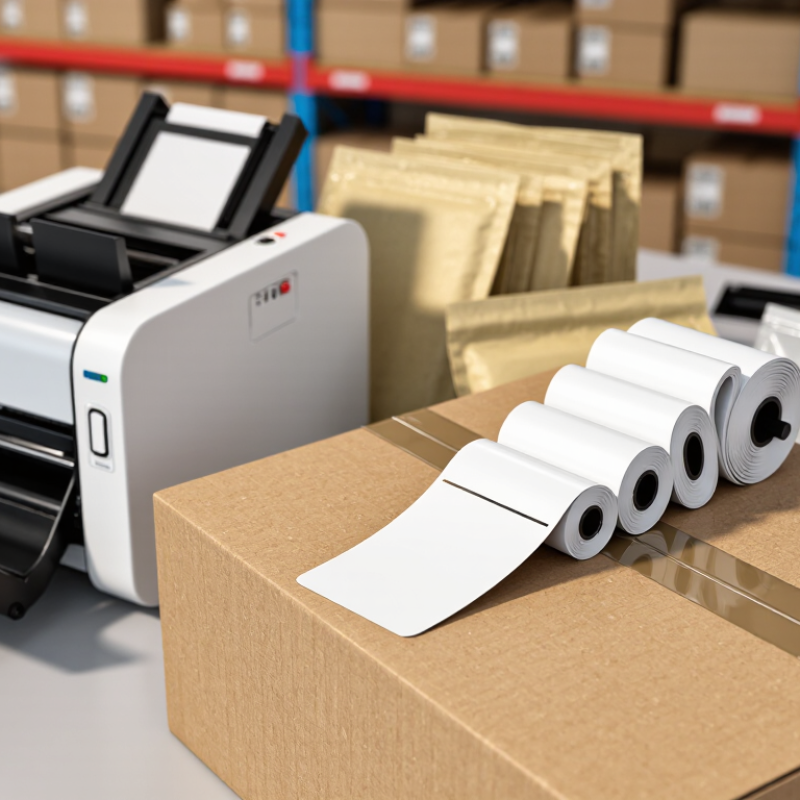
What Are 4x3 Thermal Labels and How Do They Work?
4x3 thermal labels measure four by three inches, or about 102 by 76 millimeters. They fit common parcel formats and provide enough space for addresses, barcodes, service codes, and return details. The 2024 Parcel Shipping Index reports 161.8 billion parcels worldwide in 2023. That volume makes readable, consistent labeling essential for cross-border handling.
These labels work through direct thermal printing. A printer presses a heated printhead against a chemically coated surface. Heat activates selected areas, creating text and black barcode lines without ink, toner, or ribbons.
The printer controls each heated dot, often at 203 or 300 dpi. Higher resolution can improve small barcode details, though it may increase printing time and energy use. GS1 guidance stresses clear contrast, correct sizing, and reliable barcode placement for automated scanning.
The format is not flawless. Direct thermal surfaces can darken under strong heat, sunlight, or friction. Moisture may also weaken their appearance. I would not use them blindly for long-term outdoor storage. Operators should test the actual label stock, adhesive, printer temperature, and scanner together. A label that looks sharp on a worktable may fail after condensation, stacking, or rough conveyor movement. Small details matter: a clean roller, a centered label, and correct darkness settings often prevent avoidable scanning errors.
Why 4x3 Thermal Labels Suit International Shipping Requirements
Why Choose 4x3 Thermal Labels for Global Shipping?
In warehouse testing, a well-printed 4x3 label remained easy to scan under ordinary indoor lighting. Direct thermal printing also avoids ink cartridges and reduces routine maintenance. However, label performance depends on more than size. The adhesive must match cardboard, plastic mailers, and changing temperatures. A label that grips well indoors may weaken during humid transport.
Barcode quality needs close attention. Poor contrast, low print density, or wrinkled corners can delay a parcel. Use verified shipping data and test scans before large-scale dispatch. Leave enough space around barcodes and avoid placing labels across seams or curved edges. Small details matter.
4x3 is not perfect.
Oversized customs information may require an additional document pouch or label. Some carriers also specify different dimensions, so checking current shipping instructions remains essential.
How 4x3 Thermal Labels Improve Packaging and Address Accuracy
Why Choose 4x3 Thermal Labels for Global Shipping?
A 4x3 thermal label gives essential shipping information enough room to breathe. The address, barcode, service details, and tracking number remain visually separated. In a busy packing area, that spacing matters. A cramped label can make a scanner hesitate. It can also invite manual reading errors. I have seen parcels delayed because one small digit looked like another.
Thermal printing removes the need for ink cartridges. Direct thermal labels print quickly and stay legible during routine handling. A clear barcode supports faster scans at packing benches, sorting points, and delivery depots. The format also fits many compact printers and standard cartons. Operators should confirm the label size before changing workflows. Not every shipping system uses the same layout.
Small checks protect accuracy. Match the printed address with the order record before sealing the carton. Check that the barcode is dark, complete, and free from wrinkles. Apply the label to a flat, visible surface. Avoid seams, corners, tape, and heavy curves. Humidity, sunlight, and heat can weaken some thermal images over time. That risk is easy to overlook. A label may look perfect at dispatch, yet fade during storage. Testing samples in real warehouse conditions is wiser than trusting a specification alone. Four by three works well for many parcels, but it is not a universal answer.
Which Printers and Materials Support 4x3 Thermal Labels?
A 4x3 thermal label measures approximately 102 x 76 millimeters, making it practical for shipping addresses, barcodes, and handling symbols. The Pitney Bowes Parcel Shipping Index 2024 reported 161.8 billion parcels worldwide in 2023. That volume increases pressure on fast, readable labeling. Printer compatibility matters.
Most 4x3 labels work with desktop or industrial thermal printers supporting 4-inch media width. Check the printer’s maximum print width, label gap sensor, core size, and roll diameter. A 203 dpi printer usually handles standard text and shipping barcodes. A 300 dpi model offers sharper small symbols and dense data. Direct thermal material needs no ribbon and suits short-term parcel movement. Thermal transfer material uses a ribbon and resists heat, moisture, and abrasion better. It costs more.
Choose adhesive according to the carton surface and storage conditions. A permanent adhesive may perform well on corrugated cardboard, but cold or dusty surfaces can reduce bonding. Uncoated direct thermal stock is economical, while coated stock improves image stability. Smithers’ thermal printing market analysis identifies direct thermal and thermal transfer as major application categories across logistics. Still, material claims are not universal. Test labels on real boxes first. I would not trust a perfect laboratory result alone. A small sensor mismatch can shift the barcode, which is easy to overlook.
Why Choose 4x3 Thermal Labels for Global Shipping? - Which Printers and Materials Support 4x3 Thermal Labels?
| Data Dimension | 4x3 Thermal Label Information | Recommended Printer or Material | Global Shipping Considerations |
|---|---|---|---|
| Finished Label Size | 4 × 3 inches, equal to approximately 101.6 × 76.2 mm. | Desktop, mobile, and industrial thermal printers with adjustable media guides. | The compact landscape format is widely used for parcel labels, inventory labels, return labels, and warehouse routing labels. |
| Printing Technology | Supports both direct thermal and thermal-transfer production, depending on the label stock. | Direct thermal printers for short-term labels; thermal-transfer printers for labels requiring greater resistance. | Select the technology according to transit time, storage conditions, sunlight exposure, moisture, abrasion, and regulatory retention requirements. |
| Typical Resolution | Common resolutions are 203 dpi, 300 dpi, and 600 dpi. At 203 dpi, a 4 × 3 inch image is approximately 812 × 609 dots. | 203 dpi for standard shipping text and barcodes; 300 dpi for smaller graphics or fine text; 600 dpi for highly detailed output. | Use the resolution required by the smallest text, symbol, or barcode in the shipping template rather than selecting solely by label size. |
| Direct Thermal Paper | Heat-sensitive coated paper creates the image without an ink ribbon. | Compatible with direct thermal printers using permanent or removable adhesive stock. | Cost-effective for ordinary parcel shipping, but prolonged heat, sunlight, friction, or moisture can darken or fade the image. |
| Thermal-Transfer Paper | Uncoated or coated label material receives ink from a ribbon during printing. | Thermal-transfer printers with a ribbon matched to the face stock. | Better suited to long-distance transport, outdoor exposure, warehouse storage, chemical contact, or records that must remain legible longer. |
| Synthetic Materials | Polypropylene, polyethylene, and polyester label stocks can provide improved tear and moisture resistance. | Usually paired with thermal-transfer printing; some engineered synthetic stocks support direct thermal printing. | Useful for refrigerated, humid, wet, or high-abrasion logistics environments. Confirm adhesive performance on corrugated cartons, plastic, and metal surfaces. |
| Adhesive Options | Permanent, removable, freezer-grade, high-tack, and general-purpose adhesives are available. | Choose the adhesive based on carton surface, temperature, humidity, and expected handling duration. | Cold-chain shipments may require adhesives rated for application and service at low temperatures; test adhesion before international deployment. |
| Media Roll and Core | Roll-fed 4x3 labels may use different core diameters, outer diameters, winding directions, and gap specifications. | Printer-compatible rolls, fanfold stacks, or linerless media, provided the printer is designed for that format. | Always verify the printer’s maximum roll diameter, core size, media thickness, gap or black-mark sensing, and label orientation. |
| Barcode Compatibility | The format can accommodate linear barcodes, two-dimensional codes, shipment numbers, addresses, and handling symbols. | 203 dpi is generally suitable for standard shipping barcodes; 300 dpi may help with narrow bars, small modules, or dense layouts. | Maintain adequate contrast, quiet zones, correct magnification, and a scan test across the intended transport chain. |
| Printer Languages and Workflow | Common workflows use raster images, PDF files, or printer command languages transmitted through USB, Ethernet, Wi-Fi, or Bluetooth. | Select a printer that supports the operating system, shipping software, connection method, and required command language. | Before rollout, validate international address characters, line wrapping, barcode generation, and automatic label scaling. |
| Label Orientation | 4x3 labels can be printed in portrait or landscape orientation, depending on the template and feed direction. | Printers with adjustable guides and configurable rotation provide greater layout flexibility. | Match orientation to the shipping platform’s approved template to prevent address truncation or barcode placement errors. |
| International Readability | Provides space for sender and recipient details, tracking data, routing information, and selected customs references. | Use fonts and templates that support Latin and other required character sets, subject to the shipping system’s capabilities. | Keep addresses complete, use recognized country names or codes, and avoid reducing text below a size that remains clearly readable after scanning and handling. |
| Durability Selection | Durability depends on face stock, adhesive, print technology, ribbon type, coating, and environmental exposure. | Use coated paper for general shipments and synthetic thermal-transfer stock for demanding conditions. | Perform simulated transit testing for condensation, abrasion, stacking pressure, temperature changes, and exposure to sunlight or chemicals. |
| Best-Fit Shipping Applications | Suitable for parcel identification, fulfillment, returns, cross-docking, warehouse routing, and product-to-carton labeling. | Desktop printers for low-to-medium volume; industrial or mobile printers for higher volume, field, or warehouse use. | The final choice should consider daily print volume, print speed, power availability, mobility, maintenance, media supply, and local service support. |
How to Select 4x3 Thermal Labels for Global Shipping Needs
Choosing a 4x3-inch thermal label starts with the shipment, not the printer. That size gives room for a routing barcode, address, service marks, and a small handling note. UNCTAD’s Review of Maritime Transport 2024 states that over 80% of global merchandise trade by volume moves by sea. Sea freight exposes labels to humidity, salt air, abrasion, and long dwell times. For those routes, test moisture-resistant face stock and adhesive before ordering in bulk.
Selection should follow the entire label path. Check printer resolution, roll width, core size, outside diameter, and carrier barcode rules. International barcode guidance emphasizes adequate quiet zones and strong contrast for reliable scanning. The World Bank’s 2023 Logistics Performance Index compares 139 economies across customs, tracking, infrastructure, and timeliness. This matters because a readable label can still fail when data, placement, or handoffs are inconsistent. Measure actual cartons.
Direct thermal stock is convenient for short, controlled journeys, but heat and sunlight can darken or fade it. For cross-border routes lasting weeks, thermal-transfer printing may offer stronger image permanence. Do not assume the thickest adhesive is safest; cold cartons, recycled fiber, and condensation can change performance. Run a small pilot with flat and curved boxes, including labels applied at 5°C. I have seen clean prints wrinkle at the carton seam. That failure is easy to miss in a desk test. Record scan rates after rubbing, chilling, and moisture exposure. Some specifications will need revision.
